Trout
The Eight Mountains: A NovelTrout in the rivers of Grana are more than objects of observation or a possible meal: they become a way for the narrator to learn how life moves against the current. First seen beneath a wooden bridge with Bruno, they return in memories of river exploration and a proposed camping trip. Their characteristic stillness—maintained by swimming against flowing water—gives the narrator an image through which to think about the present, the past, and the future.
Appearance and First Observation
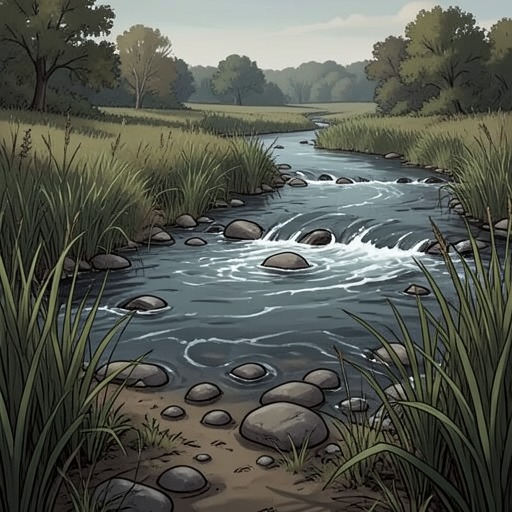
The narrator’s first close encounter with Trout takes place beside the river, where Bruno leads him to a shadowy pool beneath a small waterfall. The water is turbulent, with foam gathered at its edges and a trapped branch holding grass and sodden leaves. At first, the scene seems unremarkable: merely mountain water passing through a pool. Yet the narrator finds it absorbing before he has even understood what he is looking at.
As he watches, the surface breaks and reveals four tapering shadows, their snouts facing into the current while their tails move slowly from side to side. They shift position now and then, sometimes briefly showing their backs above the surface, but remain oriented toward the waterfall. The boys are downstream from them, so the Trout have not yet noticed their presence. The narrator tentatively identifies them as Trout; Bruno answers more generally that they are fish, and explains that they sometimes change pools.
The encounter turns on the narrator’s question about what the fish are doing. Bruno answers that they are hunting, treating the behavior as obvious. For the narrator, it is new knowledge: he had assumed fish simply swam with the current, the direction that seemed easiest. The Trout instead spend energy holding their position against it, perhaps waiting for the gnats skimming the surface. When Bruno abruptly leaps up and waves his arms, the fish scatter in every direction. Their departure leaves the narrator looking down at pale blue and white gravel, the living movement gone from the pool.
The River as a Lesson in Time
That evening, the pool returns to the narrator as he struggles to sleep. His excitement comes partly from having spent the day with someone else; his childhood has been solitary, and he feels an unfamiliar intimacy that attracts and unsettles him. He tries to settle himself by mentally retracing the scene: the waterfall, the Trout holding against the flow, and the leaves and twigs carried elsewhere by the river.
From the fish’s position, the narrator reasons, what matters arrives from upstream: insects, branches, leaves, and other things borne by the water. The Trout face the direction from which these arrivals come. He turns this observation into a distinction between past and future. Water that has already passed becomes an image of what is gone; the stream descending from above carries what has yet to arrive, including both danger and surprise. In the narrator’s formulation, the past lies down in the valley, while the future is in the mountains. The fish’s practical orientation thus becomes a framework for imagining destiny, and a response he wishes he could have given his father.
The scene also joins two kinds of attention. Bruno sees the fish’s behavior as ordinary and intelligible; the narrator has to watch, question, and revise his assumptions before he can understand it. That gap makes the pool an early setting for their friendship: Bruno’s knowledge opens a world that the narrator had not known how to see, while the narrator’s reflection gives the observed behavior a meaning beyond the immediate hunt.
Recurrence in the Boys’ Mountain Life
The Trout return as part of the boys’ broader exploration of the river. In the summer of 1987, when both are fourteen, the narrator and Bruno devote a month to following the water itself, moving upstream from the bridge at Grana. They wade and scramble through a long gorge, encounter large insect-filled pools and submerged wood, and see old, wary Trout scatter as they approach. The fish are no longer the focus of a single, quiet act of watching; they belong to a changing river landscape the boys are learning to traverse together.
Their exploration proceeds through practical obstacles. Where they cannot climb over the current, they rig a rope to cross rapids or use a fallen tree as a pontoon, wedging it between rocks. Even a modest waterfall can take hours to negotiate. The Trout’s pools mark stretches of the river within this undertaking, while the boys’ aim is to connect the difficult passages into one continuous ascent toward the river’s source. Around the August bank holiday they pass beyond Bruno’s uncle’s territory, cross a rough plank bridge, and continue into a narrowing landscape where trees thin toward the larch and the streambed gives way to scree. The fish belong to the lower, water-shaped reaches of a journey that eventually leads toward the rocky heights called Grenon.
Food, Risk, and the Trout’s Wider Meaning
Trout also appear in the narrator’s account of his father’s proposed camping trip. When the narrator is sixteen, his father plans to pitch an old, heavy army-surplus tent beside a small lake, catch Trout without being discovered by forest rangers, and roast them over a fire. The plan combines fishing, a night outdoors, and the possibility of staying up late. The narrator suspects that the camping invitation has another purpose: his father may be trying to make him speak about the distance growing between them. The fish here are part of a proposed shared outing, not the source of the conflict itself.
Across these appearances, Trout connect observation, companionship, and the use of the mountain landscape. In the pool, their resistance to the current gives the narrator a way to think about what is coming; during the river expedition, they are creatures encountered within a shared undertaking; beside the lake, they are part of his father’s imagined camp. The motif’s significance comes from these distinct contexts rather than from any claim that the fish themselves change. Their repeated presence makes the river a place where the narrator learns to look closely, to follow Bruno’s knowledge, and to give natural behavior a meaning that reaches beyond the water.